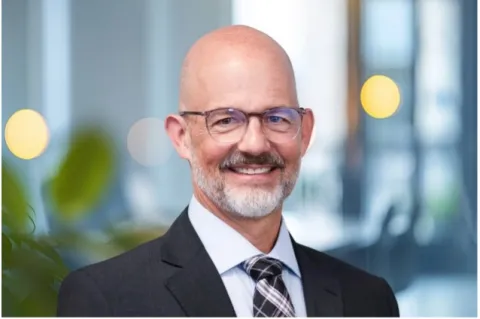
Lunch and Learn Seminar: Charles Fox, Engineering Systems, Inc.
Bio: Chuck’s career began on the rural roads of Iowa, where early experiences with his veterinarian father instilled a deep respect for community, leadership, and curiosity. After earning a doctorate at Iowa State University and completing a neuroscience fellowship at the University of Michigan, he made a bold pivot in 1994, leaving academia to join a team that pioneered the use of 3D animation in complex investigations.
What started as a temporary project blossomed into three decades of groundbreaking work at the crossroads of science, technology, and storytelling. Over the years, Chuck has guided multidisciplinary teams in creating visualization tools that bring clarity to complex scientific ideas and shed light on unseen events. When teams set out to create courtroom admissible visuals, the proper path is to start early in the investigation and use captured data like laser scans and drone imagery to remove ambiguity. These digital assets prove invaluable in mediations, arbitrations, and trials.
As Senior Director of Client Development at ESi, Chuck helps clients fully leverage the firm’s capabilities. He connects clients with teams that integrate scientific methodology with creative, collaborative problem-solving to ensure cases achieve greater clarity and impact
Abstract: Engineering models and simulations are essential to modern manufacturing and design. They also play a critical role in failure investigations. This presentation explores how forensic engineering investigations integrate 3D data capture, modeling, and laboratory testing, to understand complex, unwitnessed events.
Through examples, Dr. Fox examines how 3D methods and laboratory testing anchor models to behavior. He will show how visualization tools are used in exploratory frameworks constrained by empirical evidence before they mature into visual aids that are used to teach jurors, ultimately helping to resolve a case.
This workflow mirrors the way products are designed and manufactured. It begins with forming hypotheses, then moves to testing those ideas, and refining models within known constraints. The presentation shows that complex failures are best understood through a multidisciplinary approach. Visualization tools help teams see and understand what likely happened, while laboratory testing and analysis answer the critical question: could it have happened that way?
Agenda TBD